

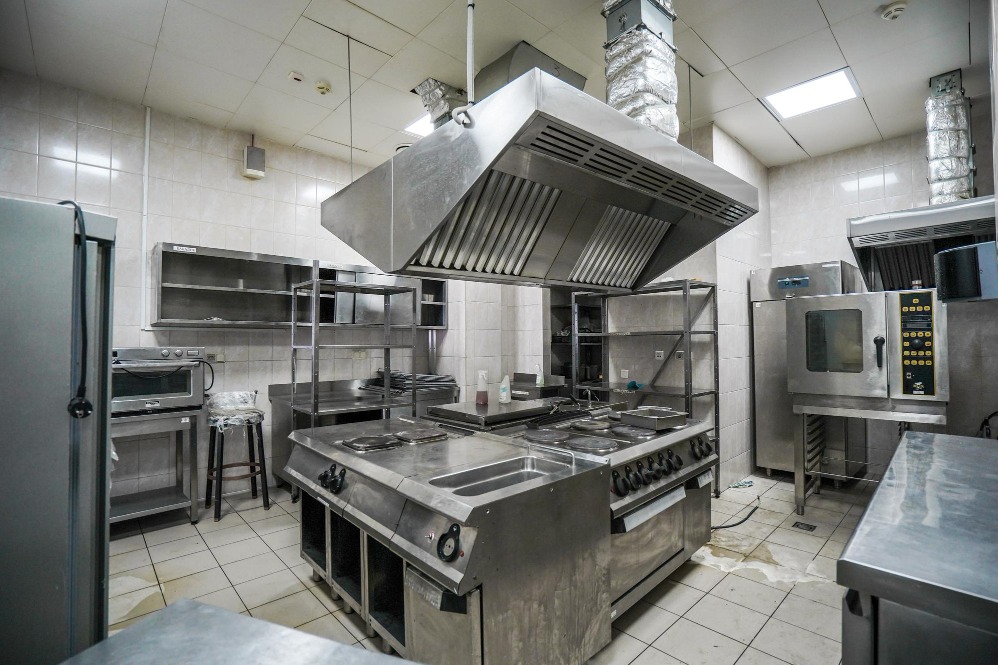
A commercial kitchen may have a powerful exhaust blower and extensive ducting yet still struggle with smoke or heat escaping into the workspace. In many cases, the problem begins at the capture point. A poorly designed or positioned SS hood can allow cooking emissions to escape before the exhaust system has an opportunity to remove them.
For Bengaluru restaurants, hotels, food courts and institutional kitchens, hood performance deserves careful attention.
Why Hood Capture Is Important
Hot cooking emissions naturally rise, carrying heat, moisture, odour and grease particles.
The hood is intended to intercept this plume before it spreads through the kitchen. Once captured, contaminated air can be drawn through filters and transported into the exhaust network.
If capture is poor, simply increasing fan speed may not fully solve the problem.
Mistake 1 Choosing Inadequate Hood Coverage
A hood that does not adequately cover the cooking equipment may allow emissions to escape around its edges.
Cooking appliance dimensions, position and heat output should therefore be considered when determining hood dimensions.
Coverage should reflect the actual cooking line rather than simply the amount of wall space available.
Mistake 2 Mounting the Hood Incorrectly
Installation height can affect capture performance.
A hood positioned improperly relative to the cooking surface may struggle to contain the rising plume. Site constraints should be addressed during design rather than compensated for later through excessive extraction.
Mistake 3 Ignoring Filter Maintenance
Grease filters can gradually become loaded during normal kitchen operation.
As resistance increases, airflow may decrease. Grease buildup can also create hygiene and fire-safety concerns.
Kitchen operators should establish routine inspection and cleaning based on cooking intensity.
Mistake 4 Treating the Hood as a Standalone Component
A stainless-steel hood cannot perform effectively without the rest of the extraction network.
Performance depends on:
- Appropriate airflow
- Correct duct sizing
- Suitable exhaust equipment
- Clean filters
- Controlled discharge
- Adequate replacement air
Every component influences the others.
Mistake 5 Ignoring Makeup Air
Commercial kitchens can exhaust substantial volumes of air.
When replacement air is inadequate, the kitchen may develop negative pressure. This can interfere with airflow patterns and create uncomfortable drafts.
A fresh-air arrangement should therefore be considered during kitchen ventilation planning.
Mistake 6 Selecting Fabrication Only by Appearance
Stainless steel provides a clean, professional appearance, but a hood is functional ventilation equipment rather than simply a decorative metal enclosure.
Fabrication quality, dimensions, filter arrangement, rigidity and cleaning access all matter.
The appropriate stainless-steel grade and thickness should also reflect the application.
Inspect the Whole Kitchen Before Making Changes
If smoke escapes from an existing hood, replacing the blower immediately may not be the best first step.
Observe where the smoke escapes, inspect filters, check fan operation and examine whether sufficient replacement air enters the kitchen.
For commercial establishments across Bengaluru, Karnataka, ventilation specialists such as Dsv Air System can evaluate the hood together with its connected extraction arrangement.
Effective SS hood performance starts with capturing cooking emissions before they spread. Correct dimensions, suitable installation, dependable airflow and routine cleaning can make the extraction network far more effective without relying on unnecessarily high fan capacity.


